

The Return of "Geopolitical Theatre"
One act for perception, another act for reality

A few weeks ago, as US threats against Greenland peaked, Europe and Canada announced troop deployments to the island. On paper, it was a new kind of “defensive posture” to uphold international rules, such as the principle that large powers cannot just seize territory from weaker or smaller states, the same rules that Canadian Prime Minister Mark Carney would later criticize and lay doubt upon at Davos.
The end result: a total of 15 German soldiers were deployed for 44 hours, part of a routine exercise. And, after backing down from a deal with China, Canada has yet to send any troops to Greenland.
As geopolitics ticks up, nations are caught between two performances. One is based in optics and perception, keeping a strong face. The other, however, is based in reality, needs on the ground, and the new geopolitical squeeze that I proposed in mid-January.

Canada-America
Most geopolitical theatre today has to do with the West’s recalibration toward the US. It is not vice versa. This is an important point. It means the US is not engaged in optics or perception. It has actually set a new trajectory for itself.
A big player in geopolitical theatre is Canada.
Ever since 51st state rhetoric began, on paper, Canada has been diversifying its relationships. Last week, Carney was in China, where he signed a highly controversial deal to allow Chinese EVs into the nation, a geoeconomic trojan horse by all measures. In March, Carney will visit India and Australia, seeking to establish a new link in Asia.
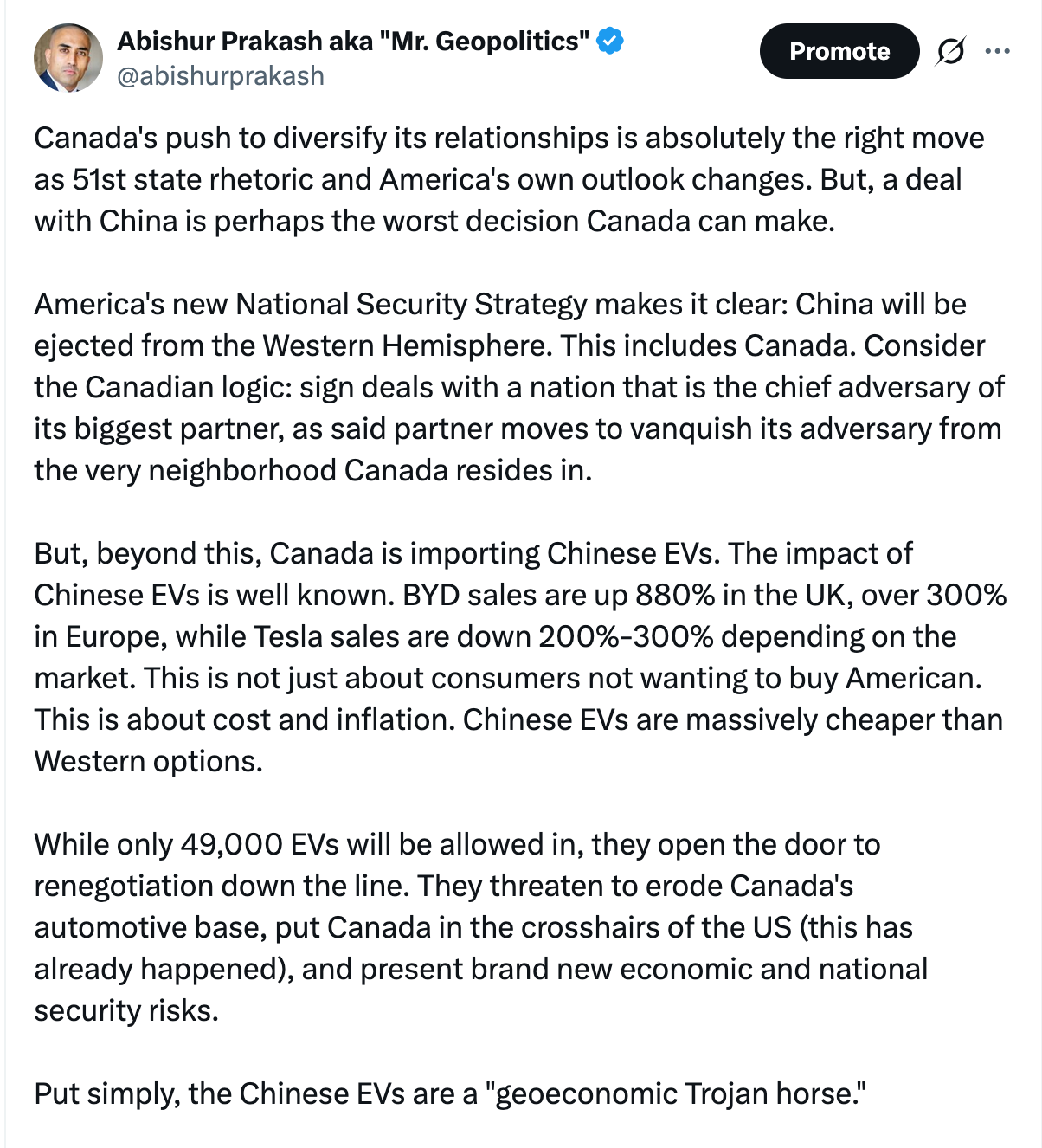
All of this makes sense. But it is also geopolitical theatre. Perhaps, Canada can redirect 1% or 2% of its trade beyond America. But, considering the new geopolitics, what is more likely is two-fold.
First, Canada’s reliance on America actually rises as its economy wobbles (i.e., a new report warns that 100,000 jobs are at risk in Canada as home sales are down 81%, a 10-year low). Second, America’s reliance on Canada drops, and Canada is left in a huge crisis as few nations scoop up Canadian goods on the same scale as the US.
Put simply, Canada’s outreach is more optics than bite. Countries like China, India, and Australia have zero reason to commit to Canada, and Ottawa knows this. Instead, Carney’s trips are about sending a message to America that Canada can still make some noise.
European Limits
It is a similar state of play with Europe.
EU President Ursula von der Leyen is visiting New Delhi as the Chief Guest for Republic Day. The so-called “mother of all deals” could be inked between Delhi and Brussels, after almost twenty years of negotiations.
However, the reality is that Europe’s export trajectory with India is completely different from America, or other Western markets. On one level, Europe wants to take advantage of India’s rising industrial and agricultural output (i.e., more European machinery). However, on the other hand, a large chunk of European exports are out of reach for most Indian consumers (i.e., luxury vehicles). All of this means that Europe’s trade corridor with India is extremely narrow, even with free trade. And, India is more likely to benefit than Europe.
The end result: Europe remains reliant on America, as an export market and also on American services.
Paradox of Change
The examples of geopolitical theatre today are endless. And, for many, a big state visit or the signing of a new deal gets the mental ideas flowing around permanent shifts or even decoupling. However, at the end of the day, it is the geopolitical and geoeconomic reality on the ground that wins.
Surrounding all of this is a strange situation and paradox.
At a moment when the entire world is in a state of flux, where everything is changing, much seems carved in stone, like the West’s continued reliance on America. There seem to be real, unrelenting parameters that restrict how far nations can go (the squeeze). These parameters are based on economic realities and decades of poor (or non-existent) future planning by governments that assumed nothing would ever change.
Now, a new dawn of geopolitical theatre has begun.
Nations are dancing and acting out of place, but the moment the curtains close, everybody is back to their old positions.
One performance is for the world, for markets, for reputation. The other performance, which few see, is for stability, security, and a recognition that even if the status quo is uncomfortable, there is nothing else that can replace it (yet).
-Abishur Prakash aka “Mr. Geopolitics”

Mr. Geopolitics is the property of Abishur Prakash/The Geopolitical Business, Inc., and is protected under Canadian Copyright Law. This includes, but is not limited to: ideas, perspectives, expressions, concepts, etc. Any use of the insights, including sharing or interpretation, partly or wholly, requires explicit written permission.