

The New Geopolitical Squeeze
Great power competition changes what's possible

As America First unleashes profound change, Canada is seeking new horizons. The Canadian prime minister, Mark Carney, has started a state visit to China, the first visit by a Canadian leader since 2017. The goal: reset relations and offset what Washington is doing.
In theory, what Canada is doing makes sense.
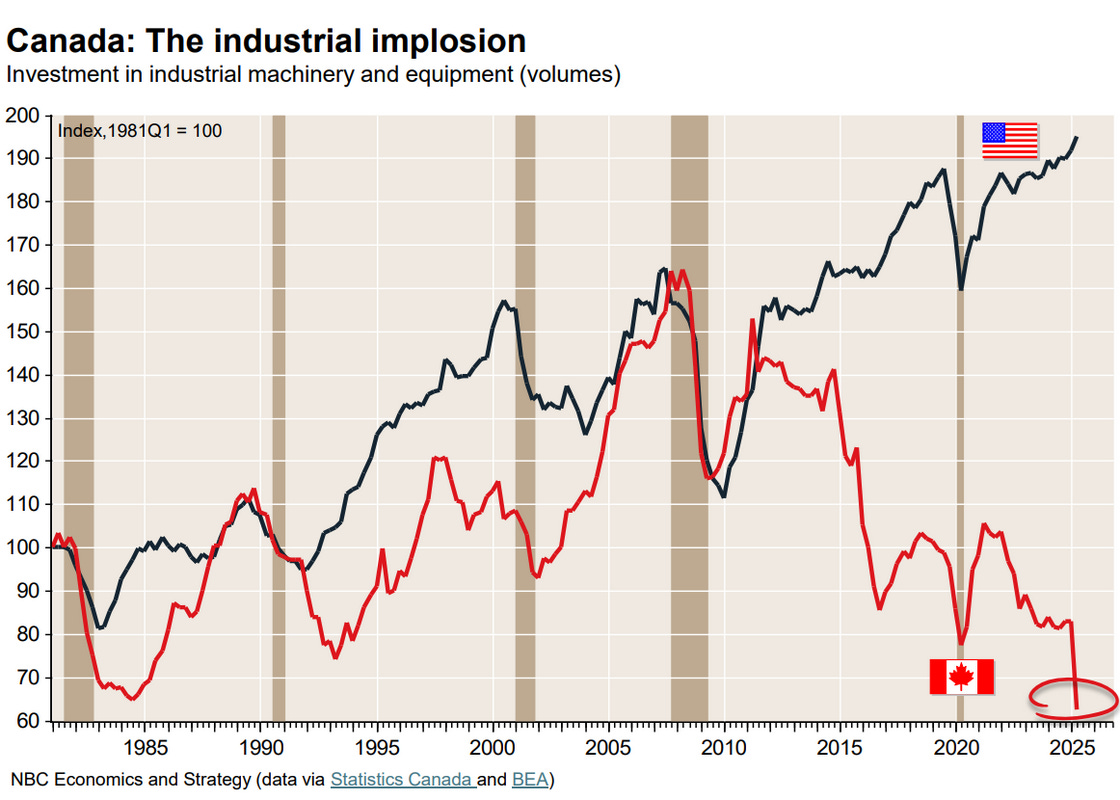
The US has become unpredictable, from trade to security. The future of USMCA is in the air. After the raid on Nicolas Maduro in Caracas, the return of Venezuelan oil could sideline Canadian oil exports to the US (around 97% of Canadian oil is purchased by America). Add to this, US threats to annex Greenland are reigniting fears that “51st state” rhetoric (or action) may return. Canada needs to reorient, fast. And, not just because of geopolitics. Canada’s economy is in turmoil. It is the worst-performing G7 economy. According to the OECD, Canada will be the worst-performing advanced economy of the 2020s - and decades after that. And, a new chart from the National Bank of Canada (below) shows how Canada’s industrial activity is plummeting in comparison to America.
In the face of this geopolitical and economic onslaught, Canada is seeking to bolster relations with China (and India).
Except, theory aside, Canada faces a reality check. It is seeking closer relations with China, at a moment when America is moving to eject Beijing from the entire Western Hemisphere, signaled by the capture of Maduro and the new US National Security Strategy that prioritizes security in North, Central, and South America over the rest of the globe.
Canada faces what can only be described as a “geopolitical squeeze.”

The new great power competition, underpinned by hard power, completely changes what smaller nations can do and how independent they can be.
It is impossible for Canada to truly decouple from America. It is even more unlikely that Canada can bring China into the picture as America’s geostrategy plays out (i.e., removing all Chinese influence and control over the Americas). As much as Canada wants to romance China, it is glued to America indefinitely.
And Canada is not alone. Dozens of nations/regions face a “squeeze” as geopolitical realities trump economic or geopolitical desires.
Another example is Europe vis-a-vis Greenland.
The Danish prime minister, Mette Frederiksen, has warned that if the US seizes Greenland, it will spell the end of NATO, the Western defense alliance. In a New York Times interview, when asked what was a higher priority, “obtaining Greenland or protecting NATO,” US President Donald Trump did not answer.
There is some truth to Frederiksen’s statements.
The likelihood of Greenland joining America voluntarily is low. This makes a US military operation more likely. European nations would treat this as a gross violation of their sovereignty and alliance. Already, Germany and France have announced they are sending soldiers to Greenland, mainly for “reconnaissance,” representing Europe’s new defensive posture, not against Russia or China, but America. Making the situation even more unprecedented is a 1952 directive from the Danish defense ministry, still in effect, that orders troops to shoot any invading force, which, in a future Greenland annexation scenario, would include US soldiers. Unlike any point in modern history, US and European guns could soon be pointing at each other.
However, even with the stakes so high, Europe cannot decouple from America, and Washington knows it.
NATO will be riddled with paranoia if Greenland joins the US, but it will not dissolve. European governments will cry foul and take action, but they will not eject US soldiers or abandon America’s nuclear umbrella. The EU will seek internal unity to deal with “American aggression,” but the flow of US capital and services into the continent will not stop. Because, the squeeze of Russia, along with Europe’s almost non-existent sovereign military capabilities, means the continent will remain pegged to the US regardless of what happens with Greenland.
Like Canada, Europe can only go so far.
It is not just US actions that are squeezing nations.
The entire Middle East and North Africa (MENA) belt is squeezed by the rapidly escalating rivalry between Saudi Arabia and the UAE, made public by Riyadh’s strike on Emirati weapon shipments in Yemen. In South Asia, it is the quiet competition between India on one side and China (and Pakistan) on the other that is strangling countries. In Southeast Asia, it is the US-China tussle forcing countries to pick sides.
Practically every region is caught in one or more geopolitical squeezes. The question in front of smaller states is how they navigate and maintain their sovereignty as great power and hard power coalesce. The geopolitical squeeze is not just about territory and land. It also draws in technology, leadership, and connectivity. Governments may be seeking recourse or rebalancing, but the status quo, often the result of decades of sustained policy, defines what is actually possible.
While the geopolitics today astonishes and shocks, it is also an opportunity to regain clarity. Nations are being made aware of their true standing and importance in the world. Many who face the music are realizing they are far smaller than they believed or imagined. At the center of this realignment with reality is a basic tenet of geopolitics: the actions of bigger powers define what nations can do.
The geopolitical squeeze has only just begun. As the oxygen levels drop, nations may be forced into positions they never gamed out.
-Abishur Prakash aka “Mr. Geopolitics”

Mr. Geopolitics is the property of Abishur Prakash/The Geopolitical Business, Inc., and is protected under Canadian Copyright Law. This includes, but is not limited to: ideas, perspectives, expressions, concepts, etc. Any use of the insights, including sharing or interpretation, partly or wholly, requires explicit written permission.