

When Beijing Laughs and Moscow Smiles
Adversaries should never be this happy

“Sit back, relax, and enjoy the ride.”
If you have ever traveled in first class or business class, you will be familiar with that line. You sit down, receive a glass of champagne, and look out the window as the plane takes you where you need to go. And, of course, follow the unstated rule: never make eye contact with those poor souls walking by you on their way to coach.
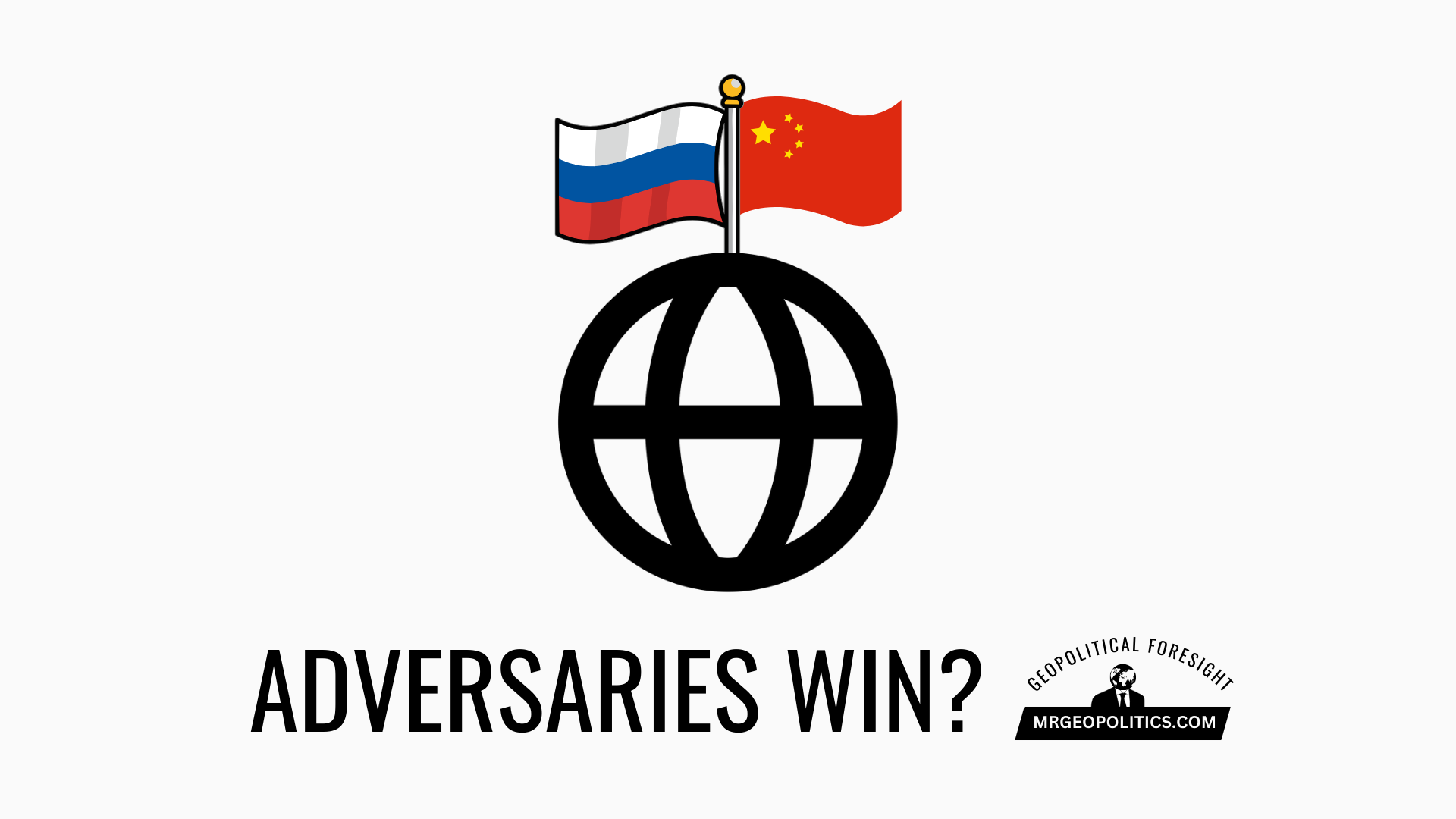
As the Western alliance implodes, China and Russia are in “geopolitical first class.” All they have to do is sit back and relax, have a drink, and watch as their biggest geopolitical desires manifest: the destabilization of NATO, a divided West, Europe lost and in shock, America without friends, nations like Australia and Japan cast to the side, all of which together make the world ripe for change.
US moves are rebalancing the world in favor of China and Russia. Let me repeat that. America’s actions are giving China and Russia the keys to the world. Are officials in Washington aware of this knock-on effect?

No Gaza Peace Board that includes the Chinese and Russians, or the French G7 outreach to Moscow, can change this. No G7 replacement that brings the US, China, and Russia into a single forum will circumvent this.
Consider the future that China and Russia are staring at:
A Europe no longer under the protection of America (end of NATO)
A highly overstretched American military, guarding parts of Asia, the Middle East, South America, the US mainland, Alaska, and Greenland
The most powerful nation in the world having no real allies, only a mix-mash of transactional relationships
A growing number of economies uncomfortable or unwilling to rely on the US or place their technological and economic future in America’s hands
The geopolitics playing out in the West today, particularly around Greenland, and Europe’s warning that it will permanently divorce America if Washington seizes the island, could do more for China and Russia than decades of rivalry ever could. With Western security in the air, could Moscow open a new front in Europe? What kind of projects will China unleash as Western nations seek economic refuge from America?
This latter part may already be materializing.
At the ongoing World Economic Forum, the French president, Emmanuel Macron, wearing sunglasses, called for more Chinese investment in Europe. This is a strange comment. Just a year earlier, Macron warned that European competitiveness depended on European innovation and financing, not on the US and China, which, if continued, would push the continent towards new irrelevance.
And, almost in lockstep, the UK has approved a Chinese “super embassy” in London after years of contention that the embassy could double as a spying hub for Beijing. Was this a reactive move by London to shore up ties with China as America’s Greenland move threatens a transatlantic decoupling?
So far, the Western calculations have been about internal unity in the face of an unhinged America. Yet, this may be the wrong approach. The only way to keep the West bound together may be to present the current struggle as a battle, not between Western nations, but between the West and its chief adversaries.
But time is running out.
Unless the West reframes what is happening, China and Russia will seize the moment. And with the West preoccupied, little will stand in the way of Beijing and Moscow rewiring the globe. This is not just about “dirty geopolitics” (i.e., regime change that brings pro-Russian or pro-Chinese governments to power).
This is also about structural realignment.
So far, the West has set its own geopolitical and geoeconomic objectives, for instance, aiding Ukraine against Russia. However, if the West implodes, all of this goes out the window. Even in the current moment, multiple cities across Ukraine are suffering from gas, electricity, and water cuts after major Russian strikes, leaving millions in a deep freeze. Yet, the spotlight is fixed squarely on Greenland. The discussion about ending the war in Ukraine or doubling down on commitments for Kyiv has disappeared. And in the backdrop, Russia fired its Oreshnik missile at Ukraine, a hypersonic warning. If America steps out, the EU may not be able to manage Ukraine and its new geopolitical reality. This would permanently alter the continent, a structural shift, and a huge win for Moscow. It would mean Russia has carte blanche in the worst European conflict since WWII.
Equally important are questions around Taiwan. If the US is occupied with Greenland or the fallout of a transatlantic trade war, how important will defending Taiwan really be?
And then, there is the big shift: the rise of multipolarity.
For decades, America has sought to keep the world dancing to its rhythm (unipolar). Yet now, it is America’s actions themselves that are driving multipolarity and could give Beijing and Moscow an outsized role in governing the globe.
The stakes have never been bigger for the West and the world.
China and Russia are quietly watching from the sidelines. Their biggest adversaries are reaching a new breaking point. Time never stands still, and neither does geopolitics. The moment Beijing and Moscow feel the West is weak enough, they could move. What this looks like and how this plays out will fall on a spectrum.
The West faces the new challenge of “dual defense.” It must defend itself from internal splits and fractures, largely driven by America First. And it must also defend itself from external actors that view the world as a jungle, and could leap at any moment.
-Abishur Prakash aka “Mr. Geopolitics”

Mr. Geopolitics is the property of Abishur Prakash/The Geopolitical Business, Inc., and is protected under Canadian Copyright Law. This includes, but is not limited to: ideas, perspectives, expressions, concepts, etc. Any use of the insights, including sharing or interpretation, partly or wholly, requires explicit written permission.