

Forget Safety. "Hostile Reliance" Has Begun.
When geopolitical desires give way to reality

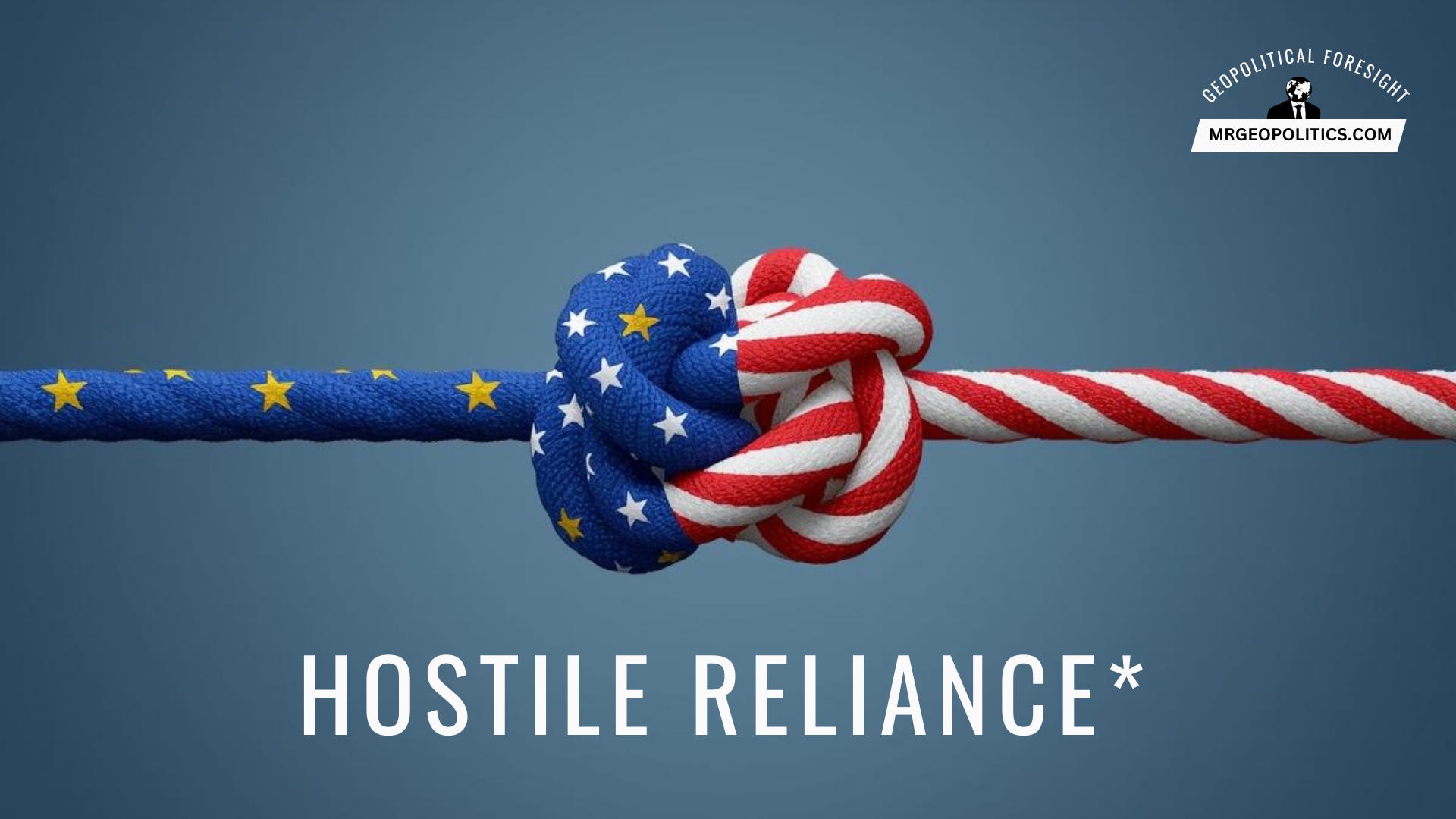
How would one characterize Europe’s continued reliance on US security and technology, at a moment when the US-EU relationship breaks down? Or, how would one characterize America’s continued reliance on China for rare earths just months after Beijing weaponized them?
So far, this has been viewed through the lens of “new geopolitics” or “economic security.” But this does not go far enough.
At a deeper level, what is really forming is a new era of “hostile reliance” in which nations rely on others whom they view as dangerous and unfriendly. Except, because there is no other option, their dependency continues.
Hostile reliance is everywhere one looks today.
Around 97% of Canadian oil exports go to the US, at a moment when America repositions Canada in its geostrategy, from its closest ally to an irrelevant neighbor.
New data shows that German investments in China in 2025 hit a four-year high, even though, from Brussels to Warsaw, European capitals warn that China poses a massive industrial threat to Europe’s future.
Even as Japan relies on China for around 60% of its rare earths, this is not stopping the Japanese government from continuing to warn that it must come to Taiwan’s rescue if China invades.
No Way Out
Until recently, reliance was accepted as the standard approach to global trade and development, even if it annoyed many (i.e., African nations exporting raw materials/commodities and then importing the refined or final product at an exponentially greater price).
Today, though, reliance is being viewed as anathema to sovereignty and security. Reliance is now purely about circumstance, not choice. Nobody wants reliance to continue.
A growing number of nations are caught in hostile reliance, and are desperately seeking a way out. But, there may be no way out.
To start with, the hostilities are likely to increase.
In Europe, planning is underway for America to shudder the flow of critical technology, like cloud computing, to the continent - what is increasingly being called a “kill switch.” This is shocking. Europe is effectively preparing for its closest ally to weaponize technology against it. This is a sign of how tumultuous US-EU relations are likely to become in the near future, increasing the hostility from both sides. Yet, what choice does Europe have? There are no real alternatives to US technology, except for China.
This leads to a second headache.
Some nations, facing hostile diplomacy, may want to switch relationships. Instead of America, they may turn to China or India. Instead of world powers, they may turn internally.
Yet, no matter what direction a government moves in, hostile reliance could present itself. Should Europe turn to China, there will be no charity. The new Canada-China EV deal is a huge strategic blunder for Canada. Not only is this an economic security risk, but it also jeopardizes the very automotive base that Canada relies on. If Canadian consumers turn to Chinese EVs, which are capped for now, purchases of American vehicles will drop, slowing production and sourcing. And if Canada reneges on its deal, China could tighten the screws on Ottawa, mimicking Washington.
As the geopolitical squeeze grows, nations will have to accept that hostile reliance cannot be avoided, it is part of the new climate.
With governments reassessing their key relationships, everything is being put under the microscope. The sound of America First is scaring the West. The laughter of China and Russia is scaring the rest. Yet, reality trumps desire. Even if economies do not like the state of play, for now, they may be stuck. Hostile reliance is the new status quo. Trade weaponization is the new card. The path forward requires planning for hostilities to increase, not aversion.
-Abishur Prakash aka “Mr. Geopolitics”

Mr. Geopolitics is the property of Abishur Prakash/The Geopolitical Business, Inc., and is protected under Canadian Copyright Law. This includes, but is not limited to: ideas, perspectives, expressions, concepts, etc. Any use of the insights, including sharing or interpretation, partly or wholly, requires explicit written permission.