

"Geopolitical Density": A New Global Paradigm
A new concept from Mr. Geopolitics

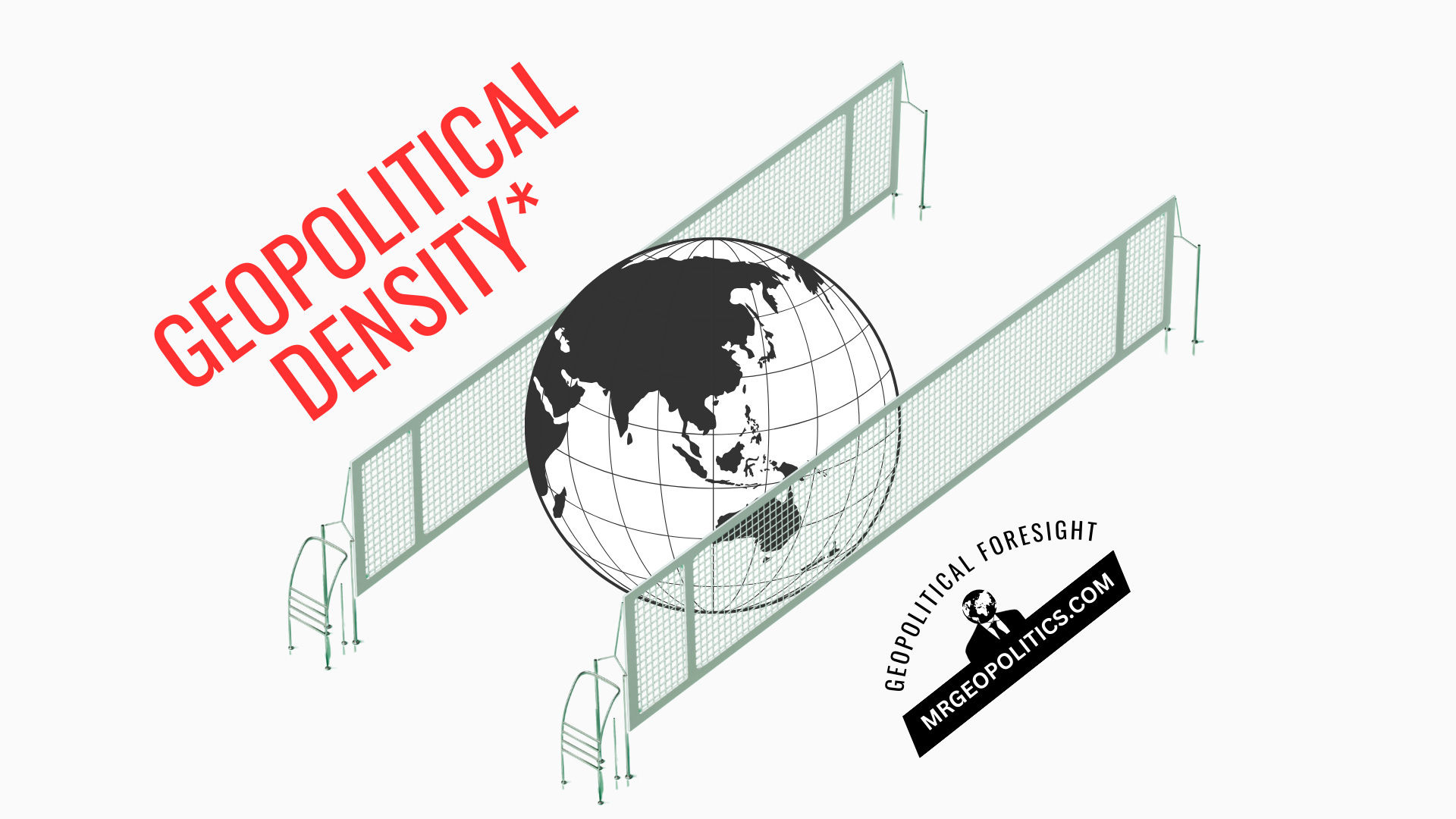
From the evolving US-China fight to the recurring wars (i.e., Cambodia-Thailand), the world has stepped into a new landscape where nothing is familiar or going according to plan.
Businesses and governments are struggling to acclimate to this new environment.
One of the reasons is that so much is occurring in such a short span of time. And nothing is happening in isolation.

This is not just about “cause and effect" (i.e., Washington banging the drum of America First, and the rest of the world reacting).
This is also about a spreading realization in capitals that staying still is the surest way to defeat. The US introduces Trump Class battleships. Days before, France announced it would be building a new aircraft carrier. Weeks before, Germany called all men 18+ for medical exams. Months before, the EU unveiled “ReArm Europe,” an 800 billion euro defense plan. The West is rushing toward a military revival all at the same time.
Defining Geopolitical Density
To navigate a world in flux, stakeholders need new paradigms.
One of them is what I call “geopolitical density.”
A decade ago, this concept would not have made sense. Today, as geopolitics flares, it is actionable. Geopolitical density is a measure of how much geopolitics is taking place in a particular region, neighborhood, or radius. And, how close in proximity the different fights and frictions are. The more geopolitics, in a tight space, the denser an area is.
Asia is #1
As it stands right now, the most geopolitically dense region of the world is Asia. Today, there are more flashpoints in Asia, packed tightly together, than any other part of the world.
This includes:
China-Philippines
China-Japan
India-Pakistan
Taiwan
US-China
Competition for Southeast Asia
There are at least a dozen more friction points littered throughout the Asia-Pacific, more than in Europe, the Americas, and Africa, combined. From a purely risk angle, this makes the Asia-Pacific the biggest priority for executives and policymakers, short-term and long-term.
Current Index
Geopolitical density is about surveying and ranking.
To calculate geopolitical density, one must be acutely aware of exactly what is happening within a particular region and what could happen next.
This is not just about being aware of a flare-up in the South China Sea or another Gen Z explosion in Europe. It is also about understanding how disruptive events, like Malaysia’s geoeconomic deal with the US, could play out long-term. This makes foresight core to geopolitical density.
Currently, this is the geopolitical density ranking as of January 2026:
Asia-Pacific (inc. Oceania)
Middle East (inc. Turkey)
Africa
Europe + Russia
Central & South America
North America
Other Angles
While geopolitical density will vary and change, there are unifying forces. Currently, the single biggest source of disruption, underpinning geopolitical density, is America First. The US actions are cascading throughout the globe, increasing the magnitude and frequency of geopolitical events.
Equally important, geopolitical density has its own nuances.
Ranking Asia-Pacific at #1 is not enough. A business or government has to go deeper and begin to unpack what places this region ahead of everywhere else. For instance, one may calculate that there are 57 friction points in Asia, versus nine in the Middle East.
In doing these calculations, geopolitical density also provides a measure of whether geopolitics is being resolved or if the world is becoming more volatile. By the end of the 2020s, should Asia jump from 57 points to 83 and Europe from 6 to 18, it will be a new indicator of why the geopolitical climate is worsening.
To measure geopolitical density for your organization, get in touch.
Lens & Tool
Geopolitical density is a lens and a tool. It is one among dozens that leaders need to succeed in the new era of geopolitics underway. Most stakeholders today have shifted gears. They are no longer shocked by geopolitics, but by how much is occurring. It is no longer about managing a single flare-up, but delegating time and resources to manage multiple at the same time, all of which are competing for the most spotlight.
Now, geopolitics has to be ranked and prioritized in ways that will squeeze most companies and governments. And this means, some battles will be allowed to rage and get bloody as organizations fight danger that is closest and most personal to them.
-Abishur Prakash aka “Mr. Geopolitics”

Mr. Geopolitics is the property of Abishur Prakash/The Geopolitical Business, Inc., and is protected under Canadian Copyright Law. This includes, but is not limited to: ideas, perspectives, expressions, concepts, etc. Any use of the insights, including sharing or interpretation, partly or wholly, requires explicit written permission.