

When Planes Move, So Does Money
Asia's new economic realignment

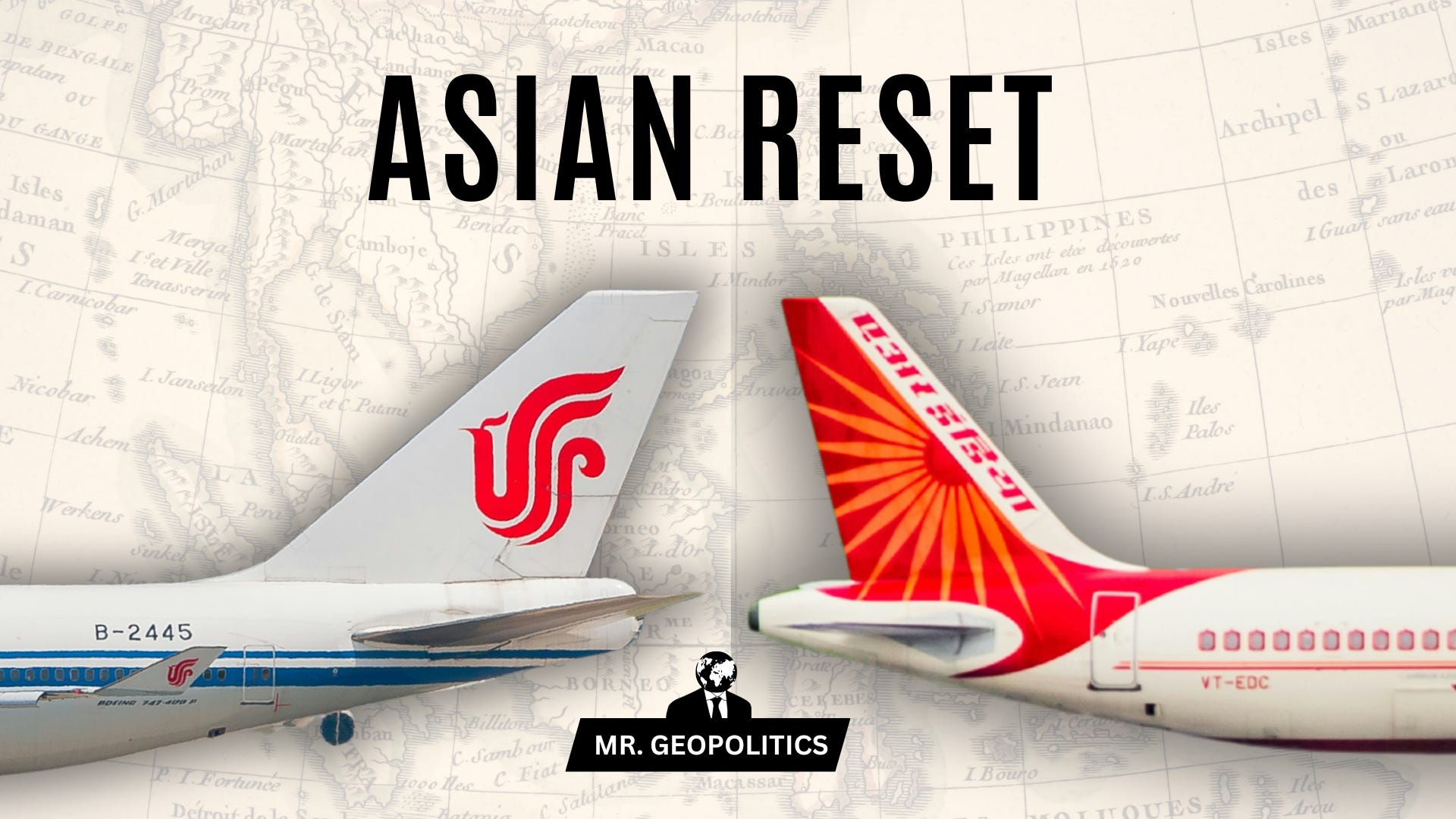
Five years after near conflict in the Himalayas froze all air routes, India and China are reopening the skies. But this is not about tourism, it is the start of an economic thaw that could redraw Asia’s balance of power.
India and China are resetting their economic links as their relationship with the US falls apart, opening the door to new trade, investment, and supply chain setups that were frozen by politics. As I have repeated several times in the past: for the first time in modern history, India and China are being united by the same headache -America First.
Suddenly, the US is watching on the sidelines as its chief rival (China) walks hand-in-hand with a nation that was supposed to be its chief partner in the 21st century (India).
The picture forming will not be received well in the White House.
Reopening The Dam
The restarting of flights means a surge in people and goods between India and China could be on the horizon. This is a deliberate strategy by both New Delhi and Beijing to slowly reopen the dam, prodding businesses and people to start reinvesting in the other’s economy.
If shockwaves from the SCO Summit are starting to materialize, the door is open to far more transformative agreements between the two emerging superpowers.
The most significant would be a restart in foreign investment, particularly Chinese state-owned or state-backed companies returning to the Indian market.

India’s Urgent Needs
This is the need of the hour for India. Even since 2020, after the flare-up, the India-China trade relationship has continued to shoot up, from $87.6 billion in annual trade when relations fell apart to $118.4 billion in 2024, well before a rapprochement began. Except, China is the big winner as it exports $101.7 billion worth of goods to India, while just bringing in $16.6 billion worth of Indian imports.
As India’s trade deficit with China widens to over $99 billion, India is facing somewhat of a foreign investment crisis. Even before tensions with Washington worsened, India’s foreign investment flows had collapsed, down 98% year-over-year in May.
For New Delhi, reengaging China may be less about geopolitics and more about pure survival.
India is eyeing opportunities to rebalance its trade relationship with China, and offset a souring investment outlook on its economy. Restarting air links could lead to both. And, the souring outlook is likely to be worsened by continued friction with the US, affecting the broader Western investor appetite for India, and making China even more pivotal to India’s future.

New Asian Dynamics
Then there are the other tie-ups between India and China. One of them could be India seeking to participate in the Regional Comprehensive Economic Partnership (RCEP), the world’s largest trade deal, which China plays a leading role in, and India has maintained distance from.
If India seeks to participate, it would further change the dynamics of the region as New Delhi aligns itself with China-backed trade networks.
Add to this, a closer relationship between India and China will be welcomed by Russia, potentially restarting RIC (Russia, India, China) as an economic bloc with a unique agenda.
This could also occur as China’s push to join the CPTPP runs into obstacles as Beijing and Tokyo square off. With the Western-backed trade bloc increasingly off limits, China could lean on RCEP even more.
Friends Competitors With Benefits
Of course, none of this suggests that India and China are on the verge of a holistic reset. Both sides are clear that their differences are too wide for them to ever be the best of friends. However, in the current geopolitical climate, their views of each other are changing: repulsion and resistance are giving way to embracing and excitement. And, it comes as the environment surrounding both countries becomes fluid, from Pakistan signing a mutual defense treaty with Saudi Arabia to Vietnam signing a trade deal with the US that edges out China.
The movement of planes could restart the movement of money. But this moment will not last forever. Like clockwork, the money could quickly be called back home. India and China are opening the door just wide enough for opportunity, but not so much that it gives way to weakness.
Both sides know a renewed collision is in the cards. And when it begins, it will start from this very runway.
-ABISHUR PRAKASH AKA. MR. GEOPOLITICS


Mr. Geopolitics is the property of Abishur Prakash/The Geopolitical Business, Inc., and is protected under Canadian Copyright Law. This includes, but is not limited to: ideas, perspectives, expressions, concepts, etc. Any use of the insights, including sharing or interpretation, partly or wholly, requires explicit written permission.