

America Wants To Replace The G7
A new global order or a new global fracture?

In geopolitics, there are events, and then there are events. The EU raiding the Dublin office of Temu is a sign of the former. The mutual defense treaty between Saudi Arabia and Pakistan is a sign of the latter.
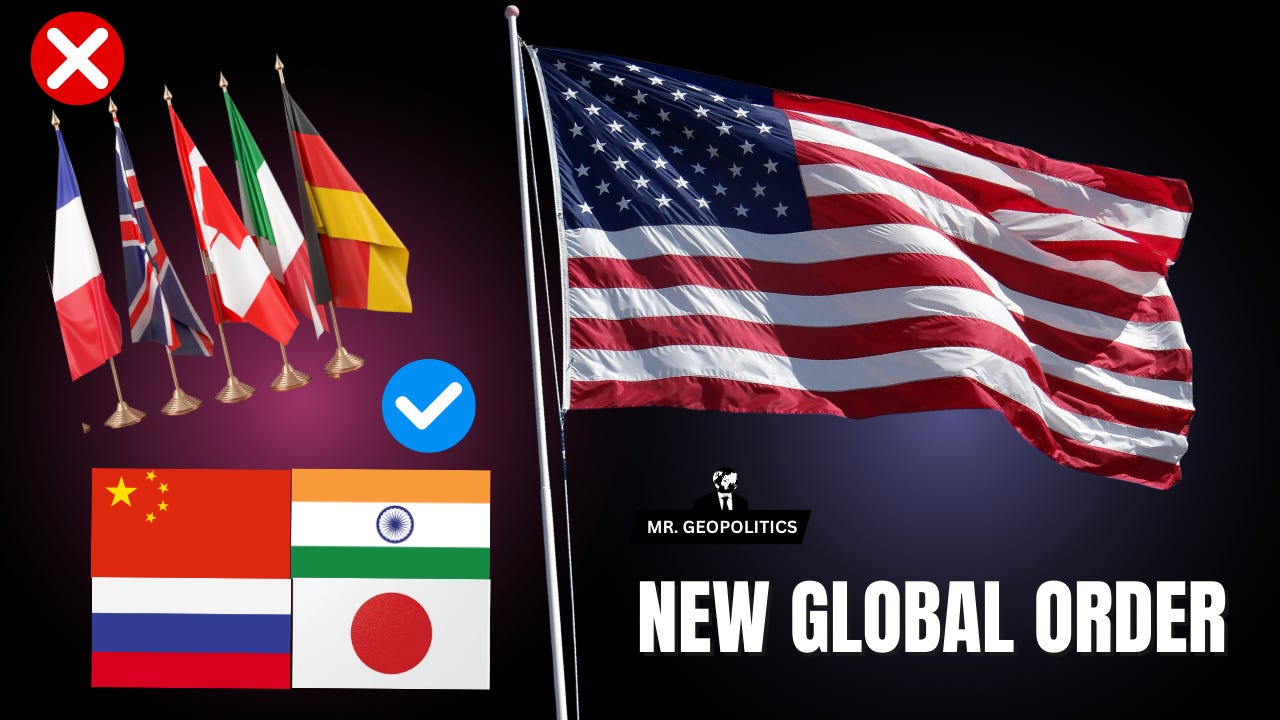
Now, another event has just occurred. A portion of the unpublished US National Security Strategy has been leaked. It is eye-opening. It calls for the creation of a new bloc that would replace the G7, referred to as “C5” (or “C7”), and made up of countries like Japan, India, China, and Russia, alongside the US.

Such an idea, from the US, is unprecedented. It should send shockwaves down the halls of power everywhere.
Whether or not C5 is created, the leak is the biggest window into America’s new geostrategy and outlook. Except for Japan, Washington views the rest of the old guard as becoming largely irrelevant to its interests and the world. It is one thing if the US treats Canada this way. It is another thing to put Germany and France in the same boat.
America’s New Global Outlook
Washington is proposing several astonishing changes at once:
The US is making it clear that its next geopolitical projects will not reinforce the Western alliance. They are about advancing America’s interests, and one of them is the US relationships with emerging superpowers.
America is prepared to rebalance global governance in ways that will limit US power. Put differently, the US is prepared to give rise to a more multi-polar world where it cannot call the shots for everybody. Instead of fighting this, Washington is proposing this.
By pivoting to the C5, the US is putting the globe on notice: the next global ideas and frameworks will not originate in the West. They will be designed by a mix-mash of nations, across ideological lines.
Watching the signals, America is pushing back against ideas like creating an AI group or BRICS, where it has no role. It is seeking a group that involves the very nations it is competing against, so decision-making remains within certain forums.
The world is returning to a bloc-based world. Yet, unlike just a few years ago, when blocs were united by a shared outlook (i.e., G7, BRICS), now they are united purely by “real power.” Those with the ability to call the shots are being invited to groups - and those without it, are being excluded.
There are two massive transformations should C5 gain life.
Economic Upheaval
First, the global economy could witness monumental change.
The C5 would set the stage for a new era of trade, economic, and technological deals that change the fundamentals of how the world works. Whether it is the US and India collaborating on AI or Russia, China, and Japan seeking a new regional economic setup, world powers could collaborate in unprecedented ways. It will be the opposite of how they currently are (cut off). Equally significant, when a global crisis strikes, it could be the C5 that introduces solutions, changing the purpose of the G7, G20, and OECD.
Sins Forgotten
Second, the leak of C5 reveals something extraordinary: the US is prepared to look past what Russia has done in Ukraine, and separately, what China may do in Taiwan.
The US is prepared to stand next to Moscow and Beijing, and shut the door on the West to ensure it can still call the shots. The message that this sends would make previous generations of American strategists toss in their grave.
Wild West
Since January, few can deny the speed of geopolitical change. Most have become de-sensitized to explosive moves, like the US threatening to kick Spain out of NATO or the outbreak of war between Israel and Iran.
Yet, the idea of a C5 that cancels out G7 is in a different league. It is about the very design of the globe, and a global order that America has built and nurtered over decades.
All of this is on its way out. And what is incoming is a setup where the lines blur between friend and foe, where ideology only goes so far, and where economics and geopolitics forever wrestle to dominate the other.
ABISHUR PRAKASH AKA. MR. GEOPOLITICS

Mr. Geopolitics is the property of Abishur Prakash/The Geopolitical Business, Inc., and is protected under Canadian Copyright Law. This includes, but is not limited to: ideas, perspectives, expressions, concepts, etc. Any use of the insights, including sharing or interpretation, partly or wholly, requires explicit written permission.